Look, you probably landed here because someone told you seo content writing is complicated. It's not. Not really.
The hard part isn't the writing. It's cutting through all the bad advice out there. Everyone's got a formula. Everyone's selling something. But after doing this for years, I can tell you most of it is noise.
SEO content writing is mostly about answering questions clearly.Everything else is details.
Here's what actually matters.
What Is SEO Content Writing
SEO content writing is the process of creating web pages that search engines can understand and people find useful.
Notice I said "people actually want to read." That's the part that gets forgotten.
You're not writing for Google's algorithm. You're writing for a person who typed something into a search bar and wants an answer. The trick is making sure Google understands what your page is about so it shows it to that person.
That's it. The rest is just technique.
If you want the step-by-step version of how on-page elements work together, our on-page SEO checklist covers everything from titles to internal links.
Why SEO Content Writing Actually Matters
Here's the truth can write the best article in the world, but if nobody finds it, it doesn't exist.
Search traffic is still one of the few free ways to get eyes on your content. Social media algorithms change every five minutes. Paid ads cost money. But a well-written page that ranks can bring people to your site for years.
I've seen articles I wrote back in 2019 still pulling organic traffic today. No ads. No promotion. Just sitting there answering the same question people keep typing into Google. That's the real reason SEO content writing matters. It's the closest thing to passive traffic you'll get online.
But the friction point nobody talks about: it's slow. Painfully slow sometimes. You can do everything right and still wait six months to see results. That's normal. It doesn't mean you messed up. It means Google doesn't trust you yet. Building topical authority takes time.
How to Write SEO Content That Ranks
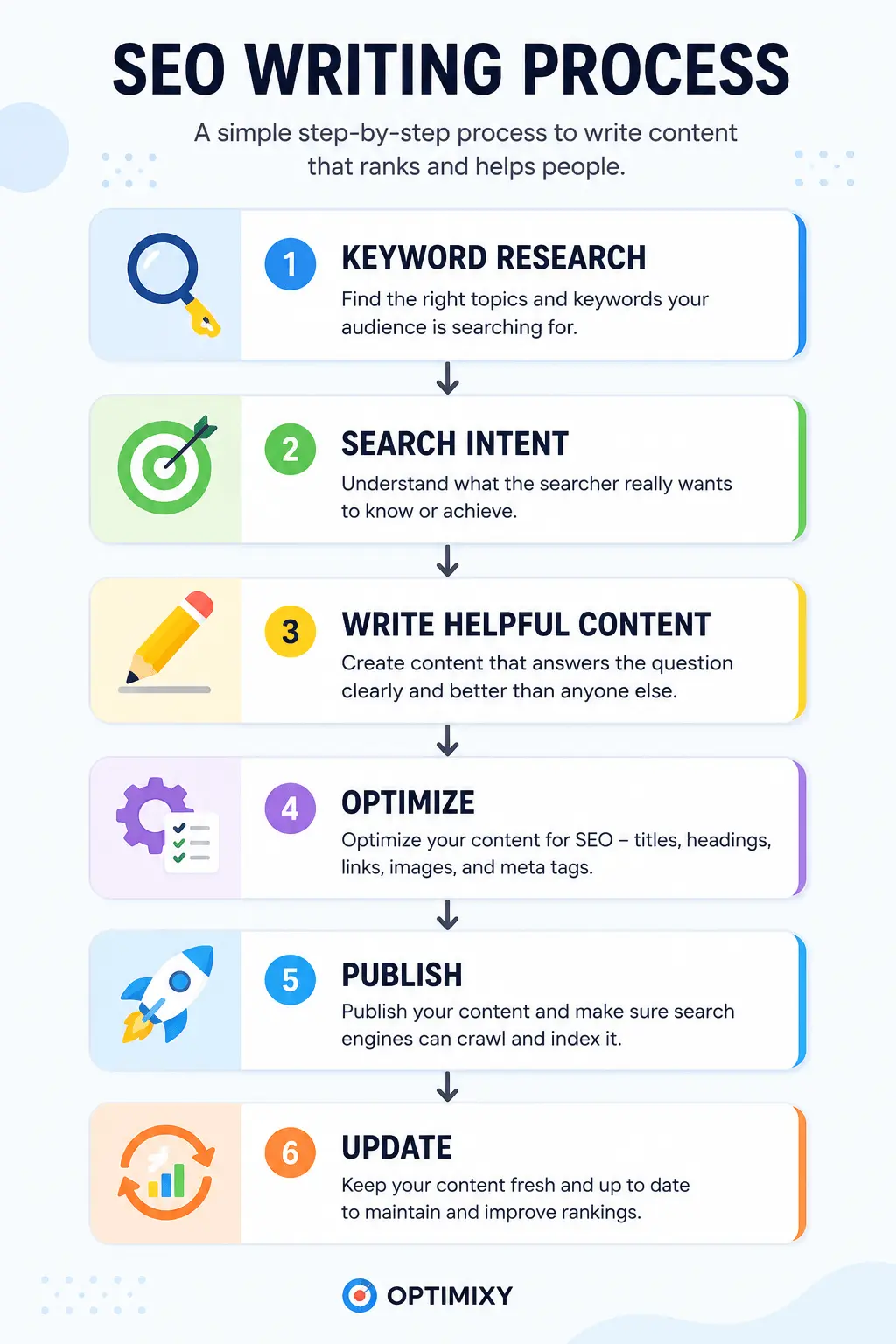
The process isn't complicated, but most people skip half the steps and wonder why nothing ranks.
First, you find out what people are searching for. Not what you THINK they're searching for. What they're ACTUALLY typing into Google. These are keywords, but that term makes it sound clinical. Think of them as questions people have. Our keyword research checklist covers the full process if you want a structured approach.
Once you know the question, figure out what kind of answer they want. Someone searching "what is a meta description" wants a definition. Someone searching "best SEO tools" wants a comparison. Same general topic. Completely different content needs. This is search intent, and getting it wrong means you won't rank no matter how good your writing is.
Then you write something that answers the question better than what's already ranking.
That last part stings a bit. You're not writing in a vacuum. You're competing with whatever's already on page one. If you haven't looked at what's ranking for your topic, you're writing blind. Open an incognito window. Search your target keyword. Read the top three results. That's your competition. Make your content better than theirs.
Before you publish, run your draft through our SEO content analyzer to catch obvious gaps. It won't write the thing for you, but it'll point out where you're missing the mark.
Before and After: SEO Writing That Works
Small changes make a big difference. Here's an example.
Before (weak):
SEO is important because SEO helps websites rank better in search engines and get more traffic from Google.
After (stronger):
Good SEO content answers the reader's question first, then explains the details clearly. That approach helps both search engines and the people you're trying to reach.
The second version leads with value instead of stating the obvious. It tells the reader why they should care.
Common SEO Content Writing Mistakes
I see the same mistakes over and over. Here are the ones that actually hurt your rankings:
- Writing for search engines instead of humans. You know those articles that say the same keyword seventeen times in weird ways? Nobody reads those. Not even Google likes them anymore.
- Targeting keywords that are too broad. "SEO" is a terrible keyword for a new site. You're competing with Moz, Ahrefs, and Google itself. Start smaller. More specific.
- Ignoring what's already ranking. Read the top three results for your keyword. If they're all 3,000-word guides, your 500-word post probably isn't cutting it.
- Not matching search intent. If someone searches "how to fix a leaky faucet," they want steps, not a history of plumbing.
- Obsessing over keyword density like it's 2008. It's not. Write naturally. Use your main phrase a few times where it fits. Move on.
- Forgetting to actually answer the question. You'd be shocked how many articles dance around the topic without ever getting to the point.
- Writing weak titles nobody clicks. Your title tag remains one of the most important on-page SEO signals. Make it clear. Make it interesting. Don't make it clickbait that disappoints people. Our SERP preview tool shows how your title actually looks in search results.
- Publishing without internal links. Every page should connect to other relevant pages on your site. It helps Google understand your site structure and keeps readers engaged. Our internal link suggestions tool finds natural linking opportunities.
- Never updating old content. This is the hack nobody uses. Instead of always writing new stuff, go back and improve what's already published. Updating important pages can improve relevance when the information has changed. Your older posts probably just need a refresh.
Practical SEO Writing Tips
Here's what I actually do when writing content for SEO:
Start with the answer. Put it near the top. Don't bury it under three paragraphs of background. People skim. Respect that. A featured snippet often comes from a concise answer near the beginning of the page.
Use headings properly. Your H1 is your main topic. Your H2s are subtopics. Your H3s are details within those subtopics. This isn't just for SEO. It makes your content scannable. Scannable content keeps people reading. Our meta tag checker shows your heading structure at a glance.
Write short paragraphs. Like this one.
Seriously. Big walls of text scare people off. You'll notice this entire article is broken into small chunks. That's on purpose. Readability matters more than most SEOs admit.
Link to other pages on your site. Internal links help Google understand your site structure and keep people clicking around. Just make sure the links make sense in context. Our on-page SEO checklist covers internal linking alongside other fundamentals.
Include related questions. The "People Also Ask" section on Google is a goldmine. Pull those questions into your article as subheadings. You're literally answering what people want to know. This also helps with featured snippets.
Don't stress about length. There's no magic word count. Some topics need 500 words. Some need 3,000. Write until you've covered the topic properly, then stop. Thin content doesn't rank. But bloated content doesn't either.
Check your readability. Our AI writing pattern analyzer helps identify whether your content sounds natural or reads like a template.
SEO Content Writing Checklist
Before you hit publish, run through this:
- ☐ Research one primary keyword and understand the search intent
- ☐ Write a compelling title tag that includes your keyword
- ☐ Start with a clear answer to the main question
- ☐ Use descriptive headings (H1, H2, H3) that structure the content
- ☐ Add internal links to relevant pages on your site
- ☐ Include related questions from People Also Ask
- ☐ Optimize images with descriptive file names and alt text
- ☐ Write a meta description that sounds human
- ☐ Proofread for readability and flow
- ☐ Plan to update the content regularly
Our SEO copywriting checklist covers the full process from research to publication.
Yes, for low-competition topics. Strong content that matches search intent can rank without backlinks if the competition is weak. For competitive terms, you'll need both content quality and authority.
SEO content writing isn't about tricks or hacks. It's about understanding what people want to know and giving them the answer in a way that's easy to find and easy to read.
If you're waiting for a magic formula, I don't have one. Neither does anyone else.
Just write something useful. Make it findable. Do it consistently. That's the whole game.
Already have content? Run it through our free SEO checker. It'll quickly spot common SEO issues and show you what to improve next.