At a Glance:
| Best For | SEO and User Experience |
| Impact on SEO | ⭐⭐⭐⭐ (small but real ranking signal) |
| Impact on UX | ⭐⭐⭐⭐⭐ (directly affects bounce and conversion) |
| Difficulty | Medium |
| Time Required | 2 to 8 hours for basic optimizations |
| Biggest Win | Image compression and caching |
Page speed optimization is one of those things everyone agrees is important and almost nobody wants to deal with. It's not creative. It's not strategic. It's just a long list of technical fixes that take time and don't feel productive until you see the results.
But the results are real. 53% of users abandon pages that take over 3 seconds to load. A faster site keeps visitors around longer. It converts better. It ranks slightly better. And unlike link building or content creation, most page speed fixes are permanent. You do them once and they keep working. The images stay compressed. The cache stays warm.
The problem is knowing where to start. Google PageSpeed Insights gives you fifty recommendations and half of them save 0.1 seconds. You could spend weeks chasing minor optimizations. Or you could focus on the fixes that actually move the needle.
One thing I've noticed after auditing hundreds of websites is that people often spend hours chasing a 100 PageSpeed score while ignoring 5 MB images. Compressing those images usually delivers a bigger improvement than several advanced optimizations combined. Start with the obvious stuff.
I've done both approaches. The focused approach gets better results faster.
Which Optimization Gives the Biggest Speed Improvement?
Not all optimizations are equal. Here's what actually moves the needle:
| Optimization | Typical Improvement | Priority |
| Compress and resize images | 20 to 70% reduction in page weight | Start here |
| Browser caching | High impact for returning visitors | Second |
| CDN | Large impact for global audiences | Second |
| Remove unused JavaScript | Moderate to high | Third |
| Faster hosting | High impact if TTFB is slow | When needed |
| Brotli compression | 10 to 20% on text assets | Easy win |
| Lazy loading | High on media-heavy pages | Easy win |
| Minify CSS and JS | 5 to 15% on code files | Easy win |
Start at the top. Work your way down. Test after each change.
Before making any changes, test your website speed to establish a baseline. Our free SEO checker measures loading speed, Core Web Vitals, performance scores, LCP, INP, and CLS so you know exactly where you stand.
Who Needs Page Speed Optimization?
Pretty much everyone. But it's especially important for:
- Blogs and content sites where images make up most of the page weight
- Ecommerce stores where every second of delay costs conversions
- SaaS companies where perceived performance affects signups
- Local businesses competing in local search results
- WordPress sites with plugin-heavy setups
- Shopify stores with product images and third-party apps
- React and Next.js applications with large JavaScript bundles
If your site takes more than 3 seconds to load, you need page speed optimization. If your Core Web Vitals are yellow or red, you need page speed optimization. If your bounce rate is high and you don't know why, you probably need page speed optimization.
How to Measure Page Speed
You can't improve what you don't measure. Here are the tools and metrics that matter.
Which Page Speed Tool Is Best?
Google PageSpeed Insights is the most accessible. Paste a URL. It shows Core Web Vitals scores, lab data from a simulated test, and field data from real Chrome users. Pros: Free, uses real Chrome data, directly relevant to Google rankings. Cons: Single URL testing, limited historical tracking.
GTmetrix combines Lighthouse and WebPageTest data. It tracks performance over time so you can see whether your changes are improving things. Pros: Historical tracking, waterfall charts, multiple test locations. Cons: Free tier has limitations, some features require account.
WebPageTest gives you the most control. Test from different locations, on different devices, with different connection speeds. Pros: Deepest diagnostic information, waterfall charts, filmstrip view. Cons: More complex interface, can be overwhelming for beginners.
Lighthouse is built into Chrome DevTools. It audits individual pages and provides detailed recommendations. Chrome DevTools also provides a Performance panel, a Network waterfall, and real-time CPU and render time analysis. Pros: Free, no external site needed, detailed debugging. Cons: Lab data only, no field data from real users.
Use all four. They serve different purposes. PageSpeed Insights for quick checks. GTmetrix for tracking. WebPageTest for deep dives. Lighthouse for debugging.
Key Performance Metrics
Here are the metrics that matter:
| Metric | What It Measures | Good Score |
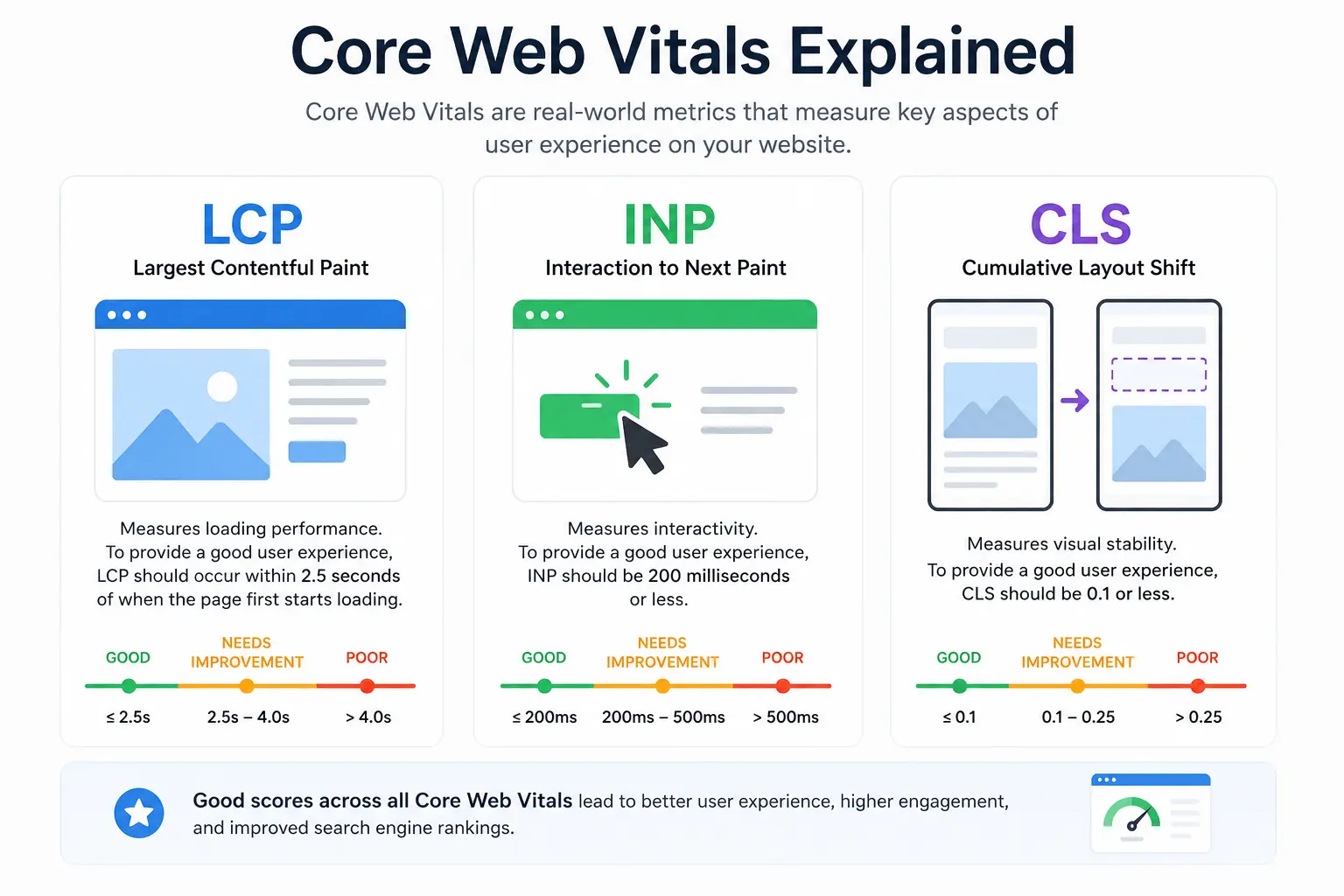
| LCP (Largest Contentful Paint) | Loading speed | ≤ 2.5 seconds |
| INP (Interaction to Next Paint) | Responsiveness | ≤ 200 milliseconds |
| CLS (Cumulative Layout Shift) | Visual stability | ≤ 0.1 |
| TTFB (Time to First Byte) | Server response time | ≤ 800 milliseconds |
| FCP (First Contentful Paint) | First visual content | ≤ 1.8 seconds |
| TBT (Total Blocking Time) | Main thread blocking | ≤ 200 milliseconds |
| Speed Index | Visual loading speed | ≤ 3.4 seconds |
What is Largest Contentful Paint? LCP measures how long it takes for the largest visible element on your page to load. It's the moment the page feels useful. A good LCP is 2.5 seconds or less.
What is Interaction to Next Paint? INP measures how quickly your page responds to user interactions like clicks and taps. It replaced First Input Delay (FID) in March 2024. A good INP is 200 milliseconds or less.
What is Cumulative Layout Shift? CLS measures how much your page layout shifts while loading. Images loading without reserved space, ads appearing dynamically, and fonts changing text size all contribute. A good CLS is 0.1 or less.
What is Time to First Byte? TTFB measures how long your server takes to start responding. It's the foundation of every other metric. A good TTFB is 800 milliseconds or less, though under 200 milliseconds is ideal.
What are render-blocking resources? Render-blocking resources are CSS and JavaScript files that stop the browser from showing anything until they're downloaded and processed. Eliminating them is one of the highest-impact optimizations.
Our free SEO checker includes page speed analysis alongside other technical issues. Our technical SEO checklist and core web vitals checklist cover performance alongside other priorities.
Test on both mobile and desktop. Mobile scores are almost always worse. Mobile devices usually have slower CPUs and connections than desktops. Google uses mobile scores for page experience evaluation, so prioritize fixing mobile issues first.
Run the test a few times. Scores vary between tests because of network conditions. Look at the average. Look at the trend over time. One test is a data point. Multiple tests are a pattern.
What Slows Down Your Website?
Before fixing anything, you need to know what's making your site slow. Most slow sites have the same handful of problems.
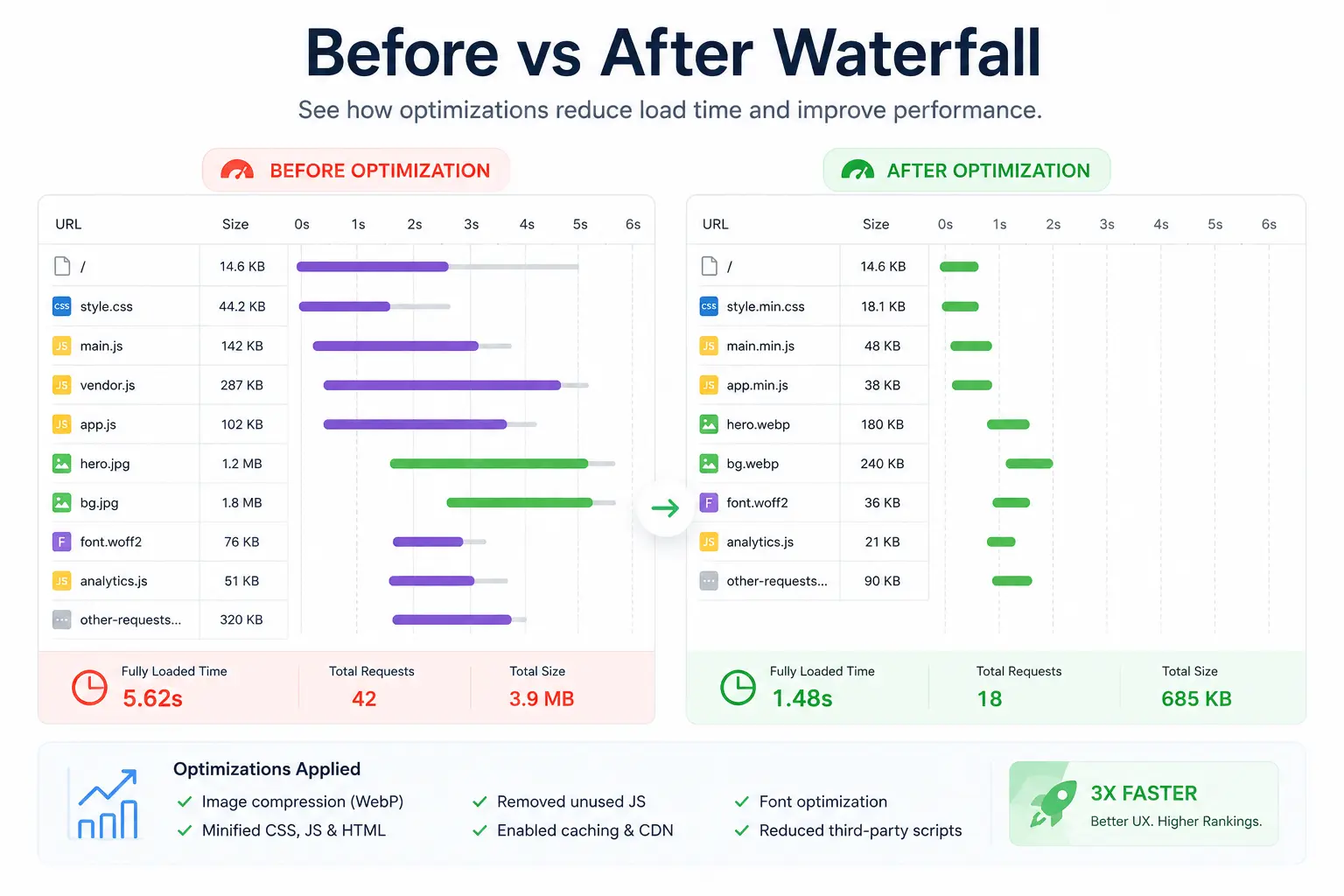
Large images are the most common cause. Someone uploads a photo straight from their camera. It's enormous. The browser downloads megabytes of data just to display a small image on the screen. Images often account for more than half of total page weight. I've seen sites where five uncompressed hero images accounted for 80% of the total page size. Fixing just those five images cut load time by more than half.
Too much JavaScript. Every plugin, every widget, every analytics tool adds JavaScript. It all has to download, parse, and execute. The browser can't show the page until it's done processing it all. A typical WordPress site loads JavaScript from a dozen different sources.
Slow hosting. Cheap shared hosting puts hundreds of sites on one server. Resources are shared. Response times are slow. Your hosting is the foundation. If it's slow, nothing else matters.
No caching. Every time someone visits your page, the server builds it from scratch. Caching stores a pre-built version and serves that instead. The difference is dramatic.
No CDN. Your server is in one location. Visitors on the other side of the world wait for data to travel across oceans.
Too many HTTP requests. Every image, every CSS file, every JavaScript file is a separate request. Each one adds overhead.
Web fonts loading from external services. Each font family and font weight is a separate download. They block text rendering until they arrive.
What Is Page Speed Optimization?
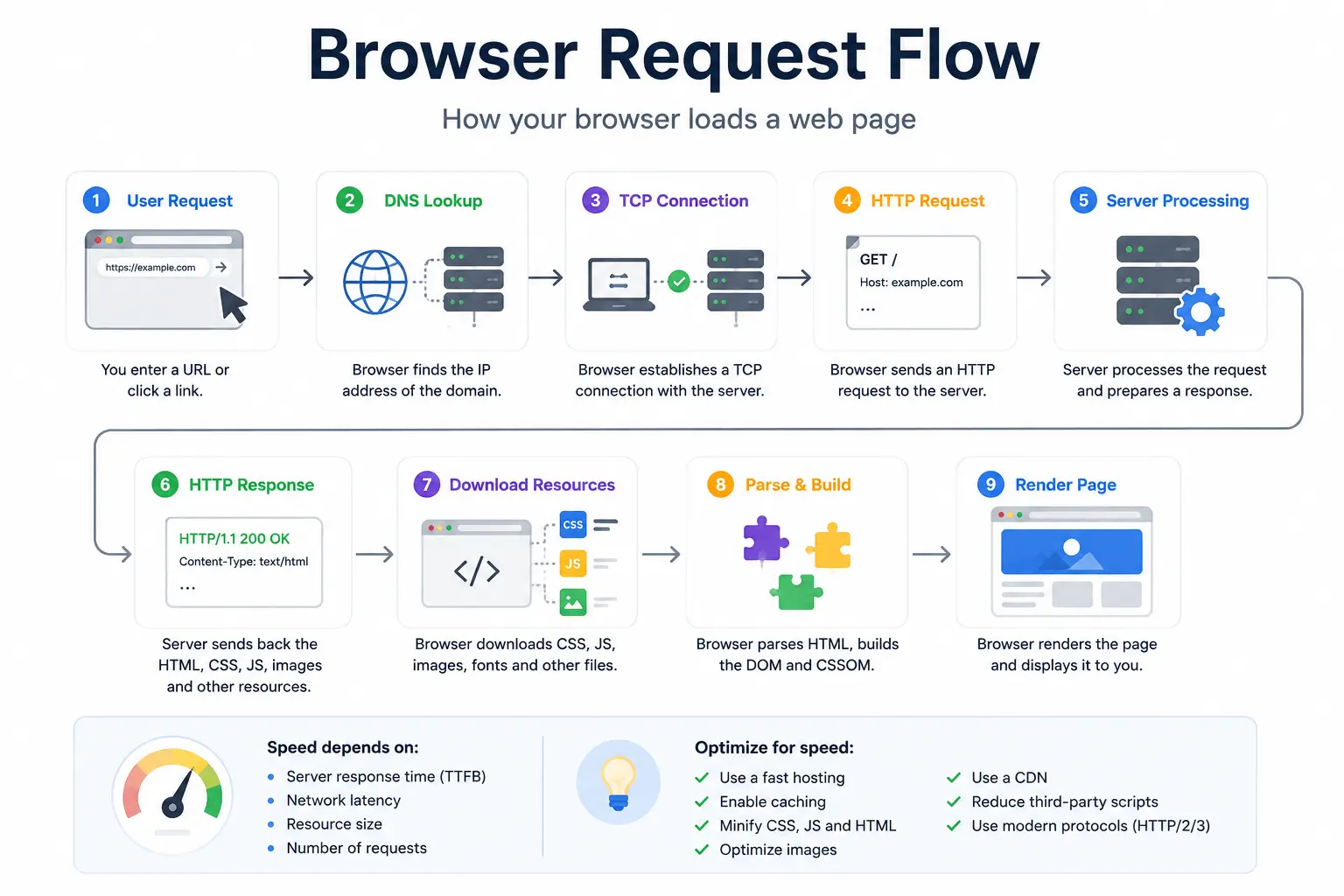
Page speed optimization is the process of reducing page load time by optimizing images, code, caching, servers, and delivery so websites load faster for users. It covers image compression, code minification, caching, content delivery networks, font loading, server configuration, and JavaScript execution.
Page speed isn't one metric. It's a collection of measurements that describe different aspects of the loading experience. Some pages load fast but feel slow because the main content appears late. Others feel fast but score poorly on technical metrics because scripts run in the background. Page speed optimization addresses both the technical measurements and the perceived experience.
1. Optimize Your Images First
Images are usually the biggest and easiest win. For most content sites, images make up more than half the page size.
Resize images to the actual display size. If your blog content area is 800 pixels wide, your images should be 800 pixels wide. Not 4000 pixels from a stock photo site. This alone can reduce image file sizes by 80 percent or more.
Compress images to reduce file size. JPEG and PNG files contain metadata and compression overhead you can strip out. Lossless compression removes unnecessary data without affecting quality. Lossy compression reduces file size more aggressively with some quality loss. Progressive JPEGs load in stages, giving visitors a preview before the full image arrives.
Use modern image formats. WebP files are typically 25 to 35 percent smaller than JPEG at the same quality. AVIF is even smaller. SVG files work well for logos, icons, and simple graphics since they scale without losing quality. Our PNG to WebP converter and image compressor handle conversion and compression automatically.
Serve responsive images. Use the srcset and sizes attributes to provide different image sizes for different screen widths. Add width and height attributes to every image so the browser reserves space before the image loads, preventing layout shifts.
Consider an image CDN. Services like Cloudinary, imgix, and Bunny Optimizer automatically resize, compress, and convert images based on the visitor's device and browser.
Our image SEO checklist covers image optimization in more detail.
2. Enable Browser and Server Caching
Caching is the closest thing to a free performance win.
Browser caching tells visitors' browsers to save images, CSS files, and JavaScript files locally. The first visit downloads everything. The second visit loads from the local cache. Set proper HTTP caching headers like Cache-Control and Expires so browsers know how long to keep files.
Server caching stores pre-built versions of your pages. Instead of your CMS building the page from scratch for every visitor, it serves the cached version.
If you're on WordPress, a caching plugin handles both. WP Rocket. Flying Press. W3 Total Cache. Pick one. Don't use two. They'll conflict.
Enable page caching. Enable browser caching. Enable GZIP compression. These three settings cover most of the benefit. Whenever you update CSS or JavaScript files, clear or version your cache so visitors receive the latest files.
3. Use a Content Delivery Network
A CDN puts copies of your site on servers around the world. When someone visits, they get the content from the nearest server.
The speed difference is noticeable. A visitor in Australia loading your site from a server in Virginia might wait 2 seconds for the first byte. The same visitor loading from a CDN server in Sydney might wait 200 milliseconds.
Cloudflare has a free tier that works for most small sites. BunnyCDN is another affordable option. Most caching plugins integrate with CDNs. Set it up once. Let it run. Many CDNs now support HTTP/3, which reduces connection setup time and handles packet loss better than HTTP/2.
4. Minify CSS, JavaScript, and HTML
Minification removes unnecessary characters from your code. Spaces. Comments. Line breaks. Everything the browser doesn't need.
The file sizes get smaller. Less data to download. Most caching plugins and CDNs do it automatically.
Enable minification in your caching plugin settings. Test after enabling. Rarely, minification breaks JavaScript that wasn't written correctly. If something stops working, disable minification for that specific file.
5. Eliminate Render-Blocking Resources
Render-blocking resources stop the browser from showing anything until they're downloaded and processed. Usually CSS and JavaScript loaded in the page head.
Inline critical CSS. The CSS needed to render the visible portion of the page should be in the HTML head, not in an external file.
Defer non-critical CSS. Load stylesheets after the page renders.
Defer or async JavaScript. Add defer or async attributes to script tags. Defer means download in the background and execute after the page loads. Async means download in the background and execute whenever.
6. Reduce Third-Party Scripts
Third-party scripts are performance killers. Analytics. Chat widgets. Social media buttons. Marketing pixels. Every one of them downloads JavaScript and executes it on your page.
Audit your scripts. List every third-party script. Ask yourself what each one actually does and whether you need it. I've seen sites with five analytics tools, three chat widgets, and tracking scripts from services they stopped using years ago. Remove the ones you don't need. Every script you remove is less JavaScript to download and execute.
For the scripts you keep, use async or defer attributes. Load non-essential scripts after the main content.
7. Implement Lazy Loading
Lazy loading delays non-critical resources until they're needed. Images below the fold. Videos. Embeds.
Add loading="lazy" to image tags. The browser only downloads the image when it's about to enter the viewport.
Replace video embeds with placeholder images. Load the actual video when the user clicks or scrolls near it.
JavaScript can be lazy loaded too. Defer scripts that aren't needed for the initial page render.
The key exception is the hero image. It should not be lazy loaded. Lazy loading the hero image makes LCP worse.
8. Optimize Web Fonts
Web fonts slow down your site in ways that aren't obvious. Each font family and font weight is a separate download.
Use fewer fonts. One for headings and one for body text is usually enough. Fewer font weights helps too. Regular and Bold cover most use cases.
Preload important fonts. Add a <link rel="preload" as="font"> tag in the page head. Include the crossorigin attribute.
Serve fonts as WOFF2 files. Self-host fonts instead of loading from Google Fonts. Use font-display: optional to prevent invisible text while fonts load.
9. Optimize Your Server
Your server is the foundation. If it's slow, everything built on top of it will be slow.
A good TTFB is under 200 milliseconds. On cheap shared hosting, TTFB is often above 800 milliseconds.
Upgrade your PHP version if you're on WordPress. PHP 8.x is significantly faster than PHP 7.x.
Enable OPcache. It stores precompiled PHP scripts in memory.
Use Redis or Memcached for object caching. These store database query results in memory.
Consider Nginx FastCGI cache or LiteSpeed Cache. LiteSpeed is optimized for WordPress and includes built-in caching. Nginx handles concurrent connections efficiently. Apache works well but may need more configuration for high-traffic sites.
Enable HTTP Keep-Alive for multiple requests over a single connection.
10. Enable GZIP or Brotli Compression
Compression reduces the size of files sent from your server to the browser.
GZIP compression is supported everywhere. Most servers enable it by default.
Brotli compression is newer and more efficient. It typically achieves 15 to 20 percent better compression than GZIP for text-based files. Most modern browsers support it.
Check whether your site is using compression. PageSpeed Insights flags uncompressed resources.
11. Reduce Redirects
Redirects add time. Every redirect means another request and response.
Fix internal links to point directly to the final URL. Fix redirect chains. Use server-level redirects instead of JavaScript redirects.
Our broken link checker finds broken links and redirect chains on your site.
12. Preload Key Resources
Preloading tells the browser to fetch important resources early.
Preload the LCP image. Preload important fonts. Preload key CSS and JavaScript files.
Don't preload everything. Preload the LCP image and critical fonts. Leave everything else alone.
13. Use Resource Hints
Resource hints help the browser prepare connections before they're needed.
DNS prefetching resolves domain names early. Preconnect goes further by establishing the TCP connection and TLS handshake. Use <link rel="preconnect"> for critical third-party origins.
14. Optimize Your Database
For dynamic sites like WordPress, the database can become a bottleneck.
Remove old data. Post revisions. Spam comments. Transient options. Use a database optimization plugin. Limit post revisions to five.
15. Reduce DNS Lookups
Every external domain requires a DNS lookup. Each one adds time.
Reduce the number of external domains. Host fonts locally. Remove unnecessary third-party scripts. Use DNS prefetching for the domains you keep.
16. Serve Scaled Images
Make sure images are served at the correct dimensions. An image that's 4000 pixels wide is overkill for an 800-pixel content area.
Resize images before uploading. For retina displays, double the dimensions. Our image compressor handles resizing alongside compression.
17. Optimize Your CSS
CSS can slow down rendering if it's bloated or poorly structured.
Remove unused CSS. Minify CSS. Inline critical CSS. Avoid CSS @import. Use <link> tags instead.
18. Optimize Your JavaScript
JavaScript is usually the biggest performance bottleneck.
Remove unused JavaScript. Split large bundles. Defer non-critical JavaScript. Avoid long tasks that run for more than 50 milliseconds. Break long tasks into smaller pieces.
19. Optimize for Mobile
Mobile page speed matters more than desktop. Google uses mobile-first indexing.
Test on mobile specifically. Use responsive images. Reduce mobile-specific overhead. Prioritize mobile fixes.
20. Fix Cumulative Layout Shift
CLS measures how much your page layout shifts while loading.
Set width and height attributes on all images and videos. Reserve space for ads and embeds. Use font-display: optional. Avoid inserting content above existing content.
Our core web vitals checklist covers layout shift optimization alongside the other Core Web Vitals.
21. Use HTTP/2 or HTTP/3
HTTP/2 allows multiple requests over a single connection. HTTP/3 uses QUIC instead of TCP, reducing connection setup time. Enable it in your CDN settings.
22. Monitor Your Core Web Vitals
Check your scores in Search Console under the Experience section. PageSpeed Insights shows Core Web Vitals scores for individual pages. Our core web vitals checklist covers the full optimization process.
23. Test Before and After Every Change
Before making any changes, run your page through PageSpeed Insights and save the results. Apply one optimization at a time. Test after each change. Compare to the baseline.
Always test on mobile.
24. Run Regular Page Speed Audits
Page speed isn't a one-time fix. Schedule quarterly audits. Check Search Console for Core Web Vitals regressions. Our SEO audit checklist covers the broader process.
25. Know When to Stop Optimizing
Page speed optimization has diminishing returns. The first few fixes make a huge difference. After that, the improvements get smaller.
If your site loads in under 2 seconds and your Core Web Vitals are green, you're done. The time is better spent on content, links, or literally anything else.
Page Speed Optimization for WordPress
WordPress powers a huge portion of the web, and it has specific optimization needs.
Caching plugins are essential. WP Rocket handles page caching, browser caching, and file optimization. FlyingPress offers similar features with a focus on Core Web Vitals. LiteSpeed Cache is ideal if your server runs LiteSpeed. Pick one plugin. Don't stack them.
Image optimization plugins compress images automatically. ShortPixel. Smush. Imagify. Some also convert images to WebP.
Perfmatters helps disable unnecessary WordPress features that slow down your site. Emojis. Embeds. Dashicons. XML-RPC. Heartbeat API. Each one adds scripts or database queries. Disabling the ones you don't need reduces overhead.
Redis object caching stores database query results in memory. Repeated queries return instantly. Most managed WordPress hosts support it.
Cloudflare integration works with most caching plugins. The free tier includes CDN, SSL, and basic performance features.
Audit your plugins regularly. Every plugin potentially adds JavaScript, CSS, and database queries. Remove the ones you don't need. Our WordPress SEO checklist covers platform-specific optimization.
Why Is My Website Still Slow? Troubleshooting Guide
If you've done the basics and your site is still slow, work through this decision tree.
Are your images optimized? If not, start there. Compress and resize every image.
Is your hosting fast enough? Check your TTFB. If it's above 800 milliseconds, your server is the bottleneck. Upgrade your hosting.
Is JavaScript slowing things down? Audit your third-party scripts. Remove unnecessary ones. Defer the rest. Check for long tasks blocking the main thread.
Are your plugins the problem? On WordPress, deactivate plugins one at a time. Test after each one. You'll find the culprit.
Is your cache working? Verify that cached pages are being served. Check your caching plugin settings. Clear the cache and test again.
Is your CDN configured correctly? Make sure static assets are being served from the CDN. Check the URLs of your images, CSS, and JavaScript files.
If everything checks out and the site is still slow, get a second opinion. Run tests in WebPageTest for deeper diagnostics. Sometimes the problem is a combination of small issues rather than one big one.
Common Page Speed Optimization Mistakes
I've made most of these. Learn from my errors.
- Chasing a perfect 100 score. A score of 100 is not the goal. A fast user experience is the goal.
- Compressing images that are already compressed. Each lossy compression pass degrades quality.
- Installing multiple caching plugins. One is good. Two conflict.
- Ignoring mobile performance. Desktop scores can look great while mobile users suffer.
- Removing JavaScript that your site actually needs to function.
- Optimizing only the homepage. Your blog posts and product pages need attention too.
- Not testing after making changes. Test. Every. Single. Time.
Page speed optimization is a game of diminishing returns. The first few fixes make a huge difference. Resizing images. Enabling caching. Setting up a CDN. These can cut your load time in half. The difference between an 8-second site and a 3-second site is life-changing.
After that, the improvements get smaller. Minifying CSS. Reducing redirects. Optimizing fonts. These are worth doing if you have time. They're not worth obsessing over if you don't. A site that loads in 2 seconds doesn't need to load in 1.8 seconds. Nobody will notice.
Focus on the fixes that actually make your pages feel faster. Not the ones that improve a score by half a point. If you're still serving large JPEG or PNG images, switching to WebP or AVIF is often the fastest performance win. If your pages load in under 2 seconds and your Core Web Vitals are green, stop optimizing. There are better uses of your time.
If your pages take 8 seconds to load, fix that today. Your visitors are leaving. They're just not telling you. They're closing the tab and clicking the next result. Speed matters. Not because Google says so. Because your visitors have attention spans measured in seconds and patience measured in milliseconds.
Start with images. Then caching. Then a CDN. Then fonts and scripts. Test after each change. Don't chase perfection. Chase fast enough. Fast enough is usually faster than you think. And once you're there, go work on something that moves the needle more. The performance rabbit hole is deep. You don't have to reach the bottom.