Well, that's it then.
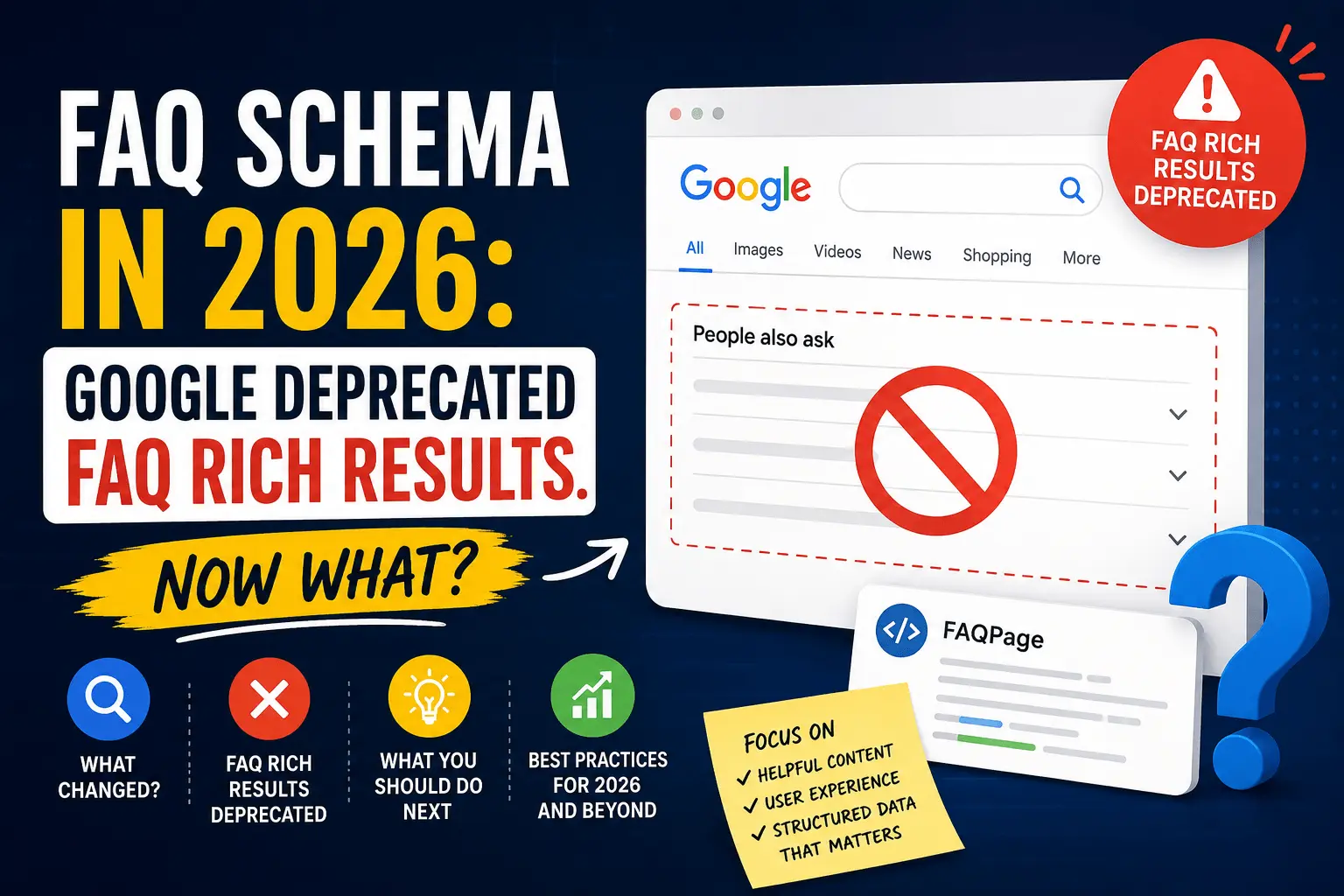
Google finally pulled the plug. As of May 7, 2026, FAQ rich results no longer appear in Google Search. The FAQ rich result report in Search Console will disappear in June 2026. They gave us a heads up this time, which is more than we usually get.
Last updated: July 2026
I've been adding FAQ schema to client sites for years. It was one of those rare SEO tactics that was easy to implement, had a visible payoff, and didn't require months of waiting. Paste the markup. Watch the rich results appear. Enjoy the CTR bump.
That era is over now.
So what do you do with the FAQ schema already on your site? Should you keep it? Remove it? Add it to new pages? The interesting question now is what to do next.
What Google Actually Announced
The deprecation notice in Google Search Console says it plainly. FAQ rich results are no longer appearing in Google Search. The report that tracked them will be removed in June 2026.
Not reduced. Not limited to authoritative sites. Gone.
This follows a pattern that started in 2023 when Google first started scaling back FAQ rich results. Then in 2024 they limited them further to well-known authoritative sites, mostly in health and government. Now in 2026, the feature is fully deprecated.
If you're seeing the notice in Search Console, it means Google has stopped showing FAQ rich results for your site. If you're not seeing it yet, you will soon. This is a global change, not an account-specific issue.
The FAQPage schema type still exists in the Schema.org vocabulary. It's not going anywhere. Google can still parse FAQPage structured data, but it no longer uses it to generate FAQ rich results in Google Search. They're just not using it to generate rich results anymore.
This is different from a penalty. You won't get a manual action for having FAQ schema. Your rankings won't drop because of it. The visible search feature that the markup powered is simply gone.
What This Means for Your Existing FAQ Schema
Here's a quick decision table for what to do right now:
| Situation | Recommendation |
| Existing FAQ schema on your site | Keep it or remove it during future maintenance |
| Creating a new blog post | Use Article schema instead |
| Product page | Use Product schema |
| Local business page | Use Local Business schema |
| Community Q&A site | Use QAPage schema |
You have three options. None of them are urgent.
Leave it. The markup doesn't hurt anything. Google still reads it. It still signals that your page contains question-and-answer content. If you have dozens of pages with FAQ schema, leaving it in place is the path of least resistance. No benefit. No harm.
Remove it. If you want to clean up your code and remove markup that no longer produces visible results, go ahead. There's no SEO downside to removing FAQ schema now. The rich result it was designed for doesn't exist anymore.
Replace it with something else. Some pages with FAQ schema might benefit from a different schema type instead. Article schema for blog posts. QAPage schema for dedicated Q&A content. Our schema markup checklist maps out which types fit different pages.
I'd lean toward leaving it for now. The effort of removing markup that isn't causing problems seems like busywork. But if you're doing a site cleanup anyway, this is a reasonable thing to strip out.
Does FAQ Schema Still Have Any SEO Value
This is where things get murky. The honest answer: probably not much.
The primary value of FAQ schema was always the visible rich result. Those expandable dropdowns took up extra space in search results. They caught the eye. They improved click-through rates measurably. That value is gone.
What's left is the indirect value. Structured data helps Google understand what your content is about. FAQ schema explicitly labels questions and answers. That might help Google match your page to question-based queries. It might contribute to how Google classifies and categorizes your content.
Does that indirect value translate to rankings? Nobody outside Google knows for sure. The connection between structured data and rankings has always been correlation rather than causation. Pages with schema tend to rank better, but that's probably because sites that care about schema also care about other SEO fundamentals.
Our what is schema markup guide covers the broader picture of how structured data fits into SEO if you want more context.
If your page already has FAQ schema, keeping it costs nothing. If you're building a new page, I wouldn't prioritize FAQ schema over other types that still produce rich results. Product schema. Article schema. Local Business schema. Those still have visible benefits.
What Schema Types Still Produce Rich Results
Just because FAQ rich results are gone doesn't mean structured data is worthless. Plenty of schema types still generate visible search features.
Product schema still shows prices, availability, and review stars in search results. Ecommerce sites should absolutely keep this in place. Our how to add schema markup guide covers the implementation.
Article schema still helps with article carousels and top stories features. If you publish news or blog content, keep this.
Local Business schema still feeds the knowledge panel and local pack results. For brick-and-mortar businesses, this remains essential.
Recipe schema still generates rich results with cook time, ratings, and ingredient lists. Recipe bloggers can breathe easy. That one survived the purge.
Review schema still shows star ratings. Review schema remains useful, but only when the reviews genuinely exist on the page. Our review schema guide covers proper implementation.
Breadcrumb schema still shows the page path in search results instead of a bare URL. Small thing, but it helps with visual polish.
FAQ schema was one of the easier wins to implement. It's frustrating to lose it. But structured data as a whole is not deprecated. Just this one type.
What About QAPage Schema
If you're looking for a replacement, QAPage schema is the closest alternative.
QAPage is designed for pages where a single question is answered, potentially with multiple answers from different people. It's the schema type used by sites like Stack Overflow and Quora. One question. One or more answers. Usually with voting or community interaction.
It's different from FAQPage. FAQPage is for pages with multiple questions and answers where the site itself provides all the content. QAPage is for community-driven Q&A formats.
Google can show rich results for QAPage schema, though it's less common than FAQ rich results ever were. If your content fits the QAPage format, switching from FAQPage to QAPage might make sense. If your content is just a list of FAQs that you wrote yourself, QAPage isn't the right fit.
Don't force QAPage schema onto content that doesn't match the format. Using the wrong schema type can confuse Google and is technically against their guidelines, even if enforcement is spotty.
How to Check If FAQ Rich Results Are Gone From Your Site
The Search Console notice tells you what's happening. But you can verify independently.
Search for queries where you used to see FAQ rich results for your pages. Use an incognito window to avoid personalization. Check whether the expandable questions still appear under your listing.
If your pages had FAQ rich results consistently and they're gone now, the deprecation has taken effect for your site.
Don't bother with the Rich Results Test tool for FAQ schema going forward. It might still validate the markup, but the test only confirms whether Google can technically process it, not whether rich results will actually appear. If your structured data still reports validation problems for other schema types, review our common schema errors guide. You can also run your markup through our free rich results tester to check for issues.
The FAQ rich result report in Search Console will be removed in June 2026. Google has announced the dedicated FAQ rich results report will be removed. Future reporting may differ, so check the latest Search Console documentation if you're troubleshooting structured data.
Should You Add FAQ Schema to New Pages
At this point, probably not.
The primary use case for FAQ schema was generating rich results. That use case is dead. The secondary use case, helping Google understand your content structure, is speculative and unproven.
If you're adding structured data to a new page, focus on schema types that still produce visible results. Article schema for blog posts. Product schema for ecommerce. Local Business schema for location pages. FAQ schema sits in a weird limbo where it still technically exists but serves no clear purpose.
Will Google ever bring back FAQ rich results? Maybe. They've deprecated and revived features before. But I wouldn't plan around that possibility. Add schema types that work today. If FAQ rich results return someday, revisit the decision then.
Our free schema markup generator handles all the still-active schema types. It's worth using for product, article, and local business markup. FAQ schema generation still works if you need it, but you probably won't.
How This Fits Into the Bigger Structured Data Picture
The deprecation of FAQ rich results follows a longer trend. Google has been cutting back on rich result types for years.
How-to rich results were restricted to desktop only in 2023, then essentially deprecated for most sites. FAQ rich results were reduced, then restricted, now removed. Google has been slowly pruning the search results page, making it cleaner and less cluttered.
Google hasn't stated that AI Overviews are the reason for this change. However, many SEO professionals believe the broader shift toward AI-powered search experiences may have reduced the need for FAQ rich results. When Google generates an AI answer at the top of the results, they don't need as many rich result features competing for attention.
Part of it is about mobile search. Expandable FAQ dropdowns work better on desktop than mobile. As mobile search dominates, features that don't translate well to small screens get cut.
And part of it is probably about click-through rates. Google wants users to find answers on the search results page itself. FAQ rich results provided answers without clicking through. But AI overviews provide even more complete answers. The FAQ feature became redundant.
Our SEO guide for beginners covers how search behavior is changing more broadly if you want the bigger picture.
FAQ rich results had a good run. They were one of the easiest SEO wins available. Paste some JSON-LD. Watch your click-through rate improve. Feel like you knew what you were doing. Our JSON-LD vs Microdata comparison explains why JSON-LD became the standard format for structured data.
It's annoying to lose a tactic that worked. But the silver lining is that everyone lost it at the same time. There's no competitive disadvantage to removing or keeping the markup. The playing field is level again, at least on this specific feature.
If you have FAQ schema on your site, leave it or remove it. Both are fine. Focus your structured data efforts on schema types that still produce visible results. Product. Article. Local Business. Recipe. The ones Google hasn't killed yet.
And if you're feeling nostalgic for the FAQ rich results era, I get it. Those expandable dropdowns were beautiful while they lasted.
Now go check your Search Console for the deprecation notice. It's probably sitting there waiting for you.
FAQ rich results had a good run. They were one of the easiest SEO wins available. Paste some JSON-LD. Watch your click-through rate improve. Feel like you knew what you were doing.
It's annoying to lose a tactic that worked. But the silver lining is that everyone lost it at the same time. There's no competitive disadvantage to removing or keeping the markup. The playing field is level again, at least on this specific feature.
If you have FAQ schema on your site, leave it or remove it. Both are fine. Focus your structured data efforts on schema types that still produce visible results. Product. Article. Local Business. Recipe. The ones Google hasn't killed yet.
And if you're feeling nostalgic for the FAQ rich results era, I get it. Those expandable dropdowns were beautiful while they lasted.
Now go check your Search Console for the deprecation notice. It's probably sitting there waiting for you.