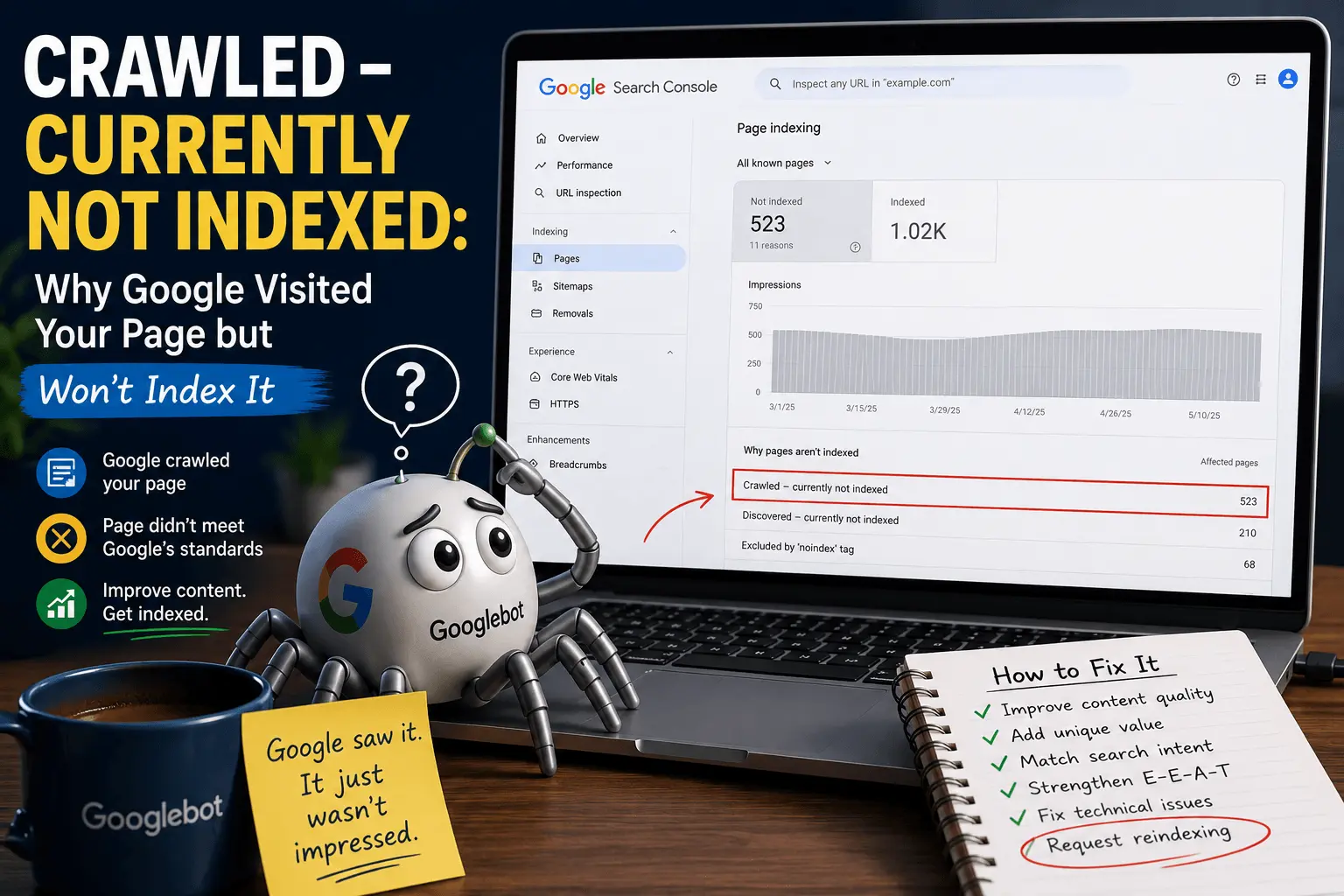
This one stings more than "Discovered – currently not indexed."
At least with discovered, you can tell yourself Google just hasn't gotten around to it yet. The page is in a queue somewhere. It'll get crawled eventually. Maybe. You can hold onto that hope. I've had clients cling to that hope for months. Sometimes it was justified. Sometimes the pages are still sitting there.
"Crawled – currently not indexed" is different. Google came. Google saw. Google said no.
Your page was good enough to attract a visit from Googlebot. That's not nothing. Google spent resources crawling it. But after reading the content, the algorithm decided this page didn't deserve a spot in the index. That's a quality judgment, not a scheduling issue. And it requires a different kind of fix.
The first time I saw this status on a page I'd written myself, it stung. I thought the content was solid. Google disagreed. I spent an hour defending the page in my head before finally accepting that maybe, just maybe, the algorithm had a point. It did. The page was fine. It wasn't great. Fine doesn't get indexed anymore.
What Does "Crawled – Currently Not Indexed" Mean
When Google crawls a page, it processes the content, evaluates the quality, and decides whether to add it to the index. "Crawled – currently not indexed" means the evaluation came back negative. The page was read. It was considered. It was rejected.
This is fundamentally different from "Discovered – currently not indexed," which we covered in our guide to discovered currently not indexed. Discovered means the page is in the crawl queue. Crawled means the page got its shot and didn't make the cut.
The decision isn't necessarily permanent. Google might recrawl the page later and change its mind if the content improves. But it won't change its mind on its own. Something has to change on the page for the next evaluation to go differently. I've watched site owners request indexing seventeen times for a page that hadn't changed. Same content. Same evaluation. Same result. Every time. The button doesn't change the content. The content is what Google is judging.
This status also appears for pages that were previously indexed and then removed. A page that was in the index for months suddenly moves to "Crawled – currently not indexed." Google recrawled it, reassessed it, and decided it no longer met the threshold. That's actually more concerning than a new page getting rejected. It means the page got worse. Or Google's standards got higher. Either way, the page is out. We'll cover this scenario in more detail in our upcoming guide on why pages drop from Google's index.
Why Google Crawls Pages Then Rejects Them
The reasons fall into a few categories. Most are about content quality. Some are technical.
Thin content is the biggest one. Google crawls the page. Finds 200 words of generic text. Maybe a stock photo. Nothing original. Nothing substantial. The algorithm decides this page doesn't add enough value to justify a spot in the index.
I've seen this on sites with lots of short posts. Each post is maybe 300 words. None of them say anything new. Google crawls them, finds them thin, and moves on. The posts that are longer, more detailed, more useful get indexed. The short ones don't. The frustrating part is when site owners tell me "but the posts are all the same length as what ranks." They're not looking at substance. They're looking at word count. Google looks at both. Word count got the page crawled. Substance determines whether it gets indexed.
Duplicate content is another common reason. Google crawls the page. Finds content that's substantially similar to something already in the index. Maybe on your site. Maybe on someone else's. The algorithm decides there's no need for another version of the same information.
This happens a lot with product descriptions copied from manufacturers. Ecommerce sites with hundreds of products using the same boilerplate descriptions. Google indexes a few. The rest get crawled and rejected. The site owner sees 500 products in their catalog and 50 in Google's index. The other 450 were evaluated and dismissed. The content wasn't bad. It just wasn't unique enough to justify 500 separate entries in the index.
Our SEO content writing guide covers how to create content that earns indexing and rankings.
Low value or low quality content. The page isn't necessarily thin. It might be 800 words. But the content is shallow. It skims the surface. It doesn't answer the question someone would search for. It reads like it was written to hit a word count, not to help anyone.
Google has gotten very good at detecting content that exists just to exist. If your page doesn't have a clear purpose and doesn't serve a clear user need, it might get crawled and rejected even if it's technically long enough. I've seen 2,000 word pages stuck in this status because the content was verbose but empty. Lots of words. No real information. The page looked substantial at a glance. Reading it revealed there was nothing there.
Content that doesn't match search intent. Someone searches for "how to fix a leaky faucet." Your page is about the history of plumbing. It might be well-written. It might be 2,000 words. But it doesn't answer the question. Google crawls it, compares it to the search query, and decides it's not what users are looking for. Not indexed.
Technical issues can also cause this. Pages with excessive JavaScript that didn't render properly during crawling. Pages that returned a 200 status but showed a blank screen or an error message. Pages with content that's only visible when logged in. Googlebot sees the wrapper but not the substance. The page looks fine to you because you're logged in. Googlebot isn't.
AI Content That Looks Different but Says the Same Thing
This is a newer problem worth addressing. In 2026, a lot of sites have hundreds or thousands of AI-generated pages. The wording is technically unique on each page. No duplication in the traditional sense. But the substance is identical.
Ten pages about "how to train a puppy." Each one is worded differently. Each one passes a plagiarism checker. But they all say the same things. Establish a routine. Use positive reinforcement. Be consistent. Socialize early. Same advice. Same structure. Same depth.
Google doesn't only compare wording. It evaluates usefulness. It looks at whether a page adds something new to the conversation or just rephrases what's already been said. When ten pages are technically unique but provide the same information, some of them often end up in "Crawled – currently not indexed."
I've seen this with programmatic SEO sites that generated content at scale. The first fifty pages got indexed. The next two hundred didn't. Not because the content was worse. Because Google had already seen the substance of what those pages were saying. The wording was different. The value was the same. And Google decided that same value didn't need 250 separate URLs in the index.
The fix for this is making each page genuinely different in substance, not just in wording. Different examples. Different angles. Different depth. Different expertise. If you can't make a page substantively unique, it probably shouldn't be a separate page. Consolidation is sometimes the right answer. Fifty thin pages become five good ones.
How This Is Different From "Discovered"
I keep emphasizing this distinction because people confuse them constantly.
"Discovered – currently not indexed" means the page is in the queue. Google knows about it. Hasn't visited yet. The fix is usually technical. Submit sitemaps. Add internal links. Improve crawl budget. Be patient.
"Crawled – currently not indexed" means the page had its chance. The fix is almost always about content. Make the page better. More substantial. More original. More useful.
If you treat a crawled-not-indexed problem like a discovered-not-indexed problem, you'll waste time on technical fixes that don't address the real issue. Resubmitting your sitemap won't help. Requesting indexing won't help. Google already crawled the page. It already decided. Technical tweaks won't change the content evaluation. I've watched people spend weeks optimizing their robots.txt and sitemap structure for pages that were thin. The sitemap was fine. The content was the problem.
Our guide to Google not indexing pages covers the broader indexing landscape.
How to Diagnose Why Your Page Was Rejected
Start with the page itself. Read it. Actually read it. Not skim it. Read it like you're a visitor who found it through search.
Does it answer a question? Does it provide information you can't find elsewhere? Does it feel complete? Does it feel original? Would you be satisfied if this was the only page you could read on this topic?
Be honest. It's easy to get defensive about your own content. But Google's algorithm doesn't have emotional attachment to your writing. If the page is thin, acknowledge it. If it's derivative, admit it. You can't fix what you won't see. I've had difficult conversations with site owners who insisted their content was great while Google had clearly decided otherwise. The algorithm isn't always right, but it's usually responding to something real. Sometimes the thing it's responding to is subtle. The structure feels templated. The examples feel generic. The page reads like a summary of other pages rather than something written by someone who actually knows the topic.
Compare your page to what's ranking. Search for the keyword you were targeting. Look at the top three results. How does your page compare? Is it shorter? Less detailed? Less helpful? Less original? If the pages that are ranking are substantially better than yours, that's why yours got rejected. The gap is usually obvious once you look.
Check for duplicate content. Copy a few sentences from your page. Paste them into Google. Do other pages show up with the exact same text? If you're using manufacturer descriptions or syndicated content, Google has already seen it. Probably many times.
Check your page for technical issues. View the page in an incognito window. Is the content visible? Does it load properly? If you have content behind tabs or accordions or JavaScript interactions, make sure Googlebot can see it.
Our free SEO checker identifies technical issues that might affect indexing.
How to Fix "Crawled – Currently Not Indexed"
The fix depends on the diagnosis. But it almost always involves improving the content.
If the content is thin, make it substantial. Add depth. Add examples. Add original insights. Add something that isn't already available on fifty other websites. This doesn't mean padding the word count. It means adding real value.
I once had a client with 200 blog posts sitting in crawled-not-indexed. Each post was about 400 words. Same format. Same structure. Same level of surface-level advice. We took the fifty most important ones and rewrote them. Expanded them to 1,200 words. Added original research. Added examples from the client's actual experience. Added unique images. Forty-three of the fifty got indexed within a month. The rest stayed in limbo because we hadn't improved them enough. The ones that got indexed were the ones where we genuinely added something new. The ones that stayed were the ones where we mostly just added words. Word count without substance doesn't fool anyone.
If the content is duplicate, make it unique. Rewrite product descriptions. Add original commentary. Add user reviews. Add comparison tables. Add anything that makes your version different from every other version of the same information.
If the content doesn't match search intent, rethink the page. What question is this page answering? What would someone search to find it? If there's a mismatch, either change the content to match the intent or change the keyword targeting to match the content.
If there are technical issues, fix them. Make sure content renders without JavaScript where possible. Make sure the page returns a clean 200 status. Make sure content isn't hidden behind login walls or interaction requirements.
After making changes, request indexing in Search Console. Paste the URL. Click "Request Indexing." Google recrawls the updated page and reevaluates. Sometimes that's enough to get it indexed.
Our SEO content analyzer can help assess whether your content meets quality thresholds before you submit it for reindexing.
When Pages Move from Indexed to Crawled-Not-Indexed
This is a specific scenario worth discussing.
A page was indexed. It was getting impressions. Maybe even clicks. Then it disappeared. Search Console now shows it as "Crawled – currently not indexed."
Something changed. Either the page changed, or Google's evaluation changed.
If you updated the page and quality dropped, that's on you. You trimmed content. You removed sections. You made it thinner. Google recrawled and noticed. Re-evaluated. Removed it.
If you didn't change the page, Google's standards might have shifted. This happens. Google updates its algorithms. Content that was good enough last year isn't good enough this year. The bar keeps rising. I've watched pages that ranked well for years suddenly drop out of the index because the rest of the internet got better and the page stayed the same. The page didn't get worse. The competition got better. That's the same thing from Google's perspective.
Competitors might have improved their content. Your page used to be the best answer. Now someone else has a better one. Google recrawled, compared, and moved your page down. Or removed it entirely.
The fix is the same. Improve the page. Make it better than it was. Better than the competitors. Submit for reindexing. Hope the new version passes the threshold. We'll cover this scenario in more detail in our upcoming guide on why pages drop from Google's index.
The Role of Site-Wide Quality Signals
Individual page quality isn't the only factor. Google also considers site-wide signals.
If your site has a lot of thin pages, even the decent pages might struggle to get indexed. Google sees the pattern. Lots of low-value URLs. It reduces its overall evaluation of the site. Pages that would be indexed on a high-quality site get rejected on a low-quality site because the overall trust isn't there.
This is why content pruning sometimes helps. Removing or improving thin pages sends a signal that your site's quality is rising. The remaining pages benefit from the improved site-wide evaluation.
I've seen sites where removing a hundred thin pages helped the remaining fifty pages get indexed. Not because those fifty pages changed. Because the overall quality signal improved. Google's trust in the site went up and the evaluation bar for individual pages went down. That's not something Google documents explicitly. It's something you observe after working with enough sites. The pattern is consistent even if the documentation isn't.
Our crawl budget guide covers site-wide quality management in more detail.
Preventing "Crawled – Currently Not Indexed"
The best prevention is publishing pages that deserve to be indexed.
Before publishing, ask whether this page adds something to the internet that doesn't already exist. If the answer is no, improve it before publishing. If you can't improve it, consider whether it should exist at all.
Don't publish for the sake of publishing. Every thin page you publish makes it harder for your good pages to get indexed. The site-wide quality signal matters. It's cumulative. Each weak page pulls down the average.
Review old content periodically. Pages that were indexed might not stay indexed forever. Google's standards evolve. Content that was acceptable two years ago might be below the threshold now. Refresh old pages. Add new information. Improve examples. Keep them current. A page that stays static while the internet improves around it will eventually be evaluated differently.
For sites publishing AI-generated content at scale, audit for substance duplication. If you have fifty pages that are technically unique but say the same things, consolidate them. Or rewrite them to be genuinely different. Or accept that many of them will end up crawled and not indexed. The algorithm doesn't reward volume anymore. It hasn't for a while.
Our blog post SEO checklist covers pre-publish quality checks.
"Crawled – currently not indexed" is Google telling you something you might not want to hear. Your page isn't good enough. Not yet.
The good news is that it's fixable. Unlike a penalty or a manual action, this is just an evaluation. Improve the content. Make it better. More substantial. More original. More useful. Google will recrawl eventually. And when it does, the evaluation might go differently.
What doesn't work is ignoring the problem and hoping it resolves itself. Google already read your page. It already decided. The page isn't going to magically become more indexable by sitting there unchanged. I've watched pages sit in this status for over a year because the site owner kept waiting instead of improving. Waiting isn't a strategy. It's just waiting.
Fix it or remove it. Those are the options that actually work. Publishing more thin pages in the meantime just makes the problem worse. The signal accumulates. Google's evaluation of your site doesn't reset each week. It builds over time.
Now go look at your Search Console. Find those crawled-not-indexed pages. Read them honestly. Ask yourself if you'd be satisfied landing on that page from a Google search. If the answer is no, you know what to do. If the answer is yes and Google still disagrees, compare it to what's ranking. You might notice things you missed. I've been there. It's humbling. But it's also fixable. Start rewriting.