You type something into Google. Hit enter. Results show up almost instantly.
Feels simple.
But there's a lot happening in that split second.
Nothing magical, though. It's more like a massive system sorting and pulling information really fast.
Let's go through it step by step.
First, Forget Everything Marketing People Told You
You've probably heard stuff like "Google has 200 ranking factors" or "you need to optimize for semantic search."
Look… most of that is overcomplicated nonsense.
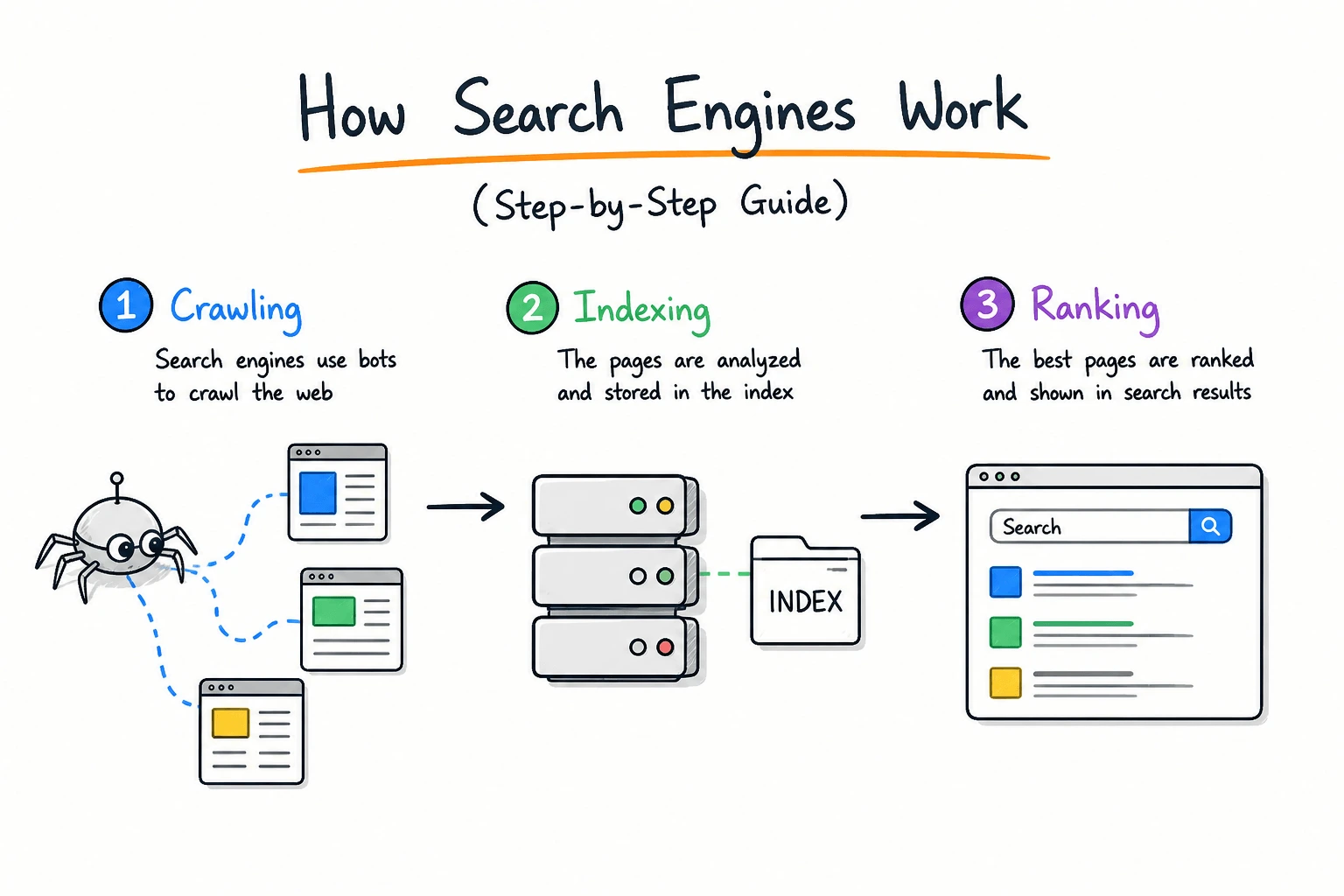
Search engines do three basic things:
- Crawling — finding pages on the web
- Indexing — storing what they find
- Ranking — deciding which pages to show first
That's it. Everything else is just details.
Now let me explain each part.
Step One: Crawling (The Internet Roomba)
Search engines have little programs called crawlers. You might hear them called spiders or bots. Same thing.
They're not smart. At all.
They just go from link to link to link. A crawler lands on a page, reads the links on that page, visits those pages, then reads the links on those pages, and keeps going.
It's like dropping a marble in a pinball machine and letting it bounce around forever.
Here's the part most SEO courses skip.
If nobody links to your page, crawlers might never find it.
Think about it. How would they? They only follow links.
No links means no path. It's not that they're ignoring you. They just don't know you exist.
So yeah, links matter. Not because of some fancy algorithm idea… but because that's literally how crawlers move around the web.
If you want search engines to discover your content faster, submit an XML sitemap and make sure your robots.txt file isn't accidentally blocking important pages.
Step Two: Indexing (Taking Messy Notes)
Once a crawler finds your page, it reads it.
Sort of.
It's not like a person reading. It's more like someone skimming a book while half distracted and writing a few notes.
The crawler looks at:
- The page title
- Headings and subheadings
- The main text content
- Images and their descriptions
- Links to other pages
- When the page was last updated
Then it stores that information in a giant database called the index.
People think the index is a perfect copy of every webpage. It's not.
It's more like a messy card catalog. Enough information to find the page later, but not everything.
This matters because if your page isn't clear about what it's about, the index gets it wrong. And once that happens… everything else struggles.
If your pages aren't appearing in search results, use our Indexability Checker to verify Google can crawl and index them properly.
Step Three: Understanding Your Question
Now you type something.
Let's say: "why does my coffee taste bitter"
The search engine has to figure out what you actually mean.
Do you want an explanation? A quick fix? A video?
Here's what it does:
- Ignores filler words like "does" or "my"
- Focuses on the important parts: "coffee," "bitter," "why"
- Looks at related ideas — maybe pages that say "over-extracted" or "sour." Same idea, different wording
- May consider your location and search history for context
All of this happens insanely fast. Milliseconds.
This is why keyword research matters — you need to understand what people are actually searching for, not just what you think they're searching for.
Step Four: Finding Pages That Might Work
Now the search engine searches through the index.
It pulls out every page that might be relevant to your query.
This part is fast. Really fast.
There could be millions of pages that mention coffee and bitterness.
But you don't want millions. You want the best few.
So now comes the hard part.
Step Five: Ranking (The Messy Part)
This is where search engines try to figure out which pages deserve to show first.
And yeah… they get it wrong sometimes.
Here's what they look at:
Does the page actually answer the question?
Sounds obvious, but a lot of pages don't. They talk around the topic instead of answering it directly.
Is it clear and readable?
Not fancy writing. Just easy to understand. Use our SEO Content Analyzer to check your readability.
Do people find it useful?
If users click a result and leave immediately, that's a bad sign. If they stay, that's a good one.
Is the content still relevant?
Some topics age fast (news, trends). Others don't (how to tie a tie). Search engines try to tell the difference.
Are there other sites linking to it?
This still matters. A lot. Links are like signals that say "this page is worth checking." Learn more about link building and why it matters.
People try to fake this. They buy links, trade links, build networks. Sometimes it works for a while. Then it doesn't.
Step Six: Building the Results Page (What You Actually See)
After ranking, the search engine builds the page you see.
It's not just a list of links anymore. Depending on your query, you might see:
- Featured snippets at the top
- Knowledge panels on the side
- Image or video results
- Related questions ("People also ask")
- Local business listings
This part is easy to overlook. But it matters, because the search engine is not just ranking pages… it's deciding how to present them.
This is where schema markup comes in — it helps search engines understand your content and display it as rich results like FAQ dropdowns, star ratings, or product information.
Step Seven: Why Rankings Keep Changing
Here's something people don't expect.
Search engines don't figure things out once and stop. They keep updating constantly.
New content gets published. Old pages get updated. Some pages disappear entirely.
And search engines adjust rankings based on this.
What this means for you: it's not random. It's just a system constantly re-evaluating content.
Regular SEO audits help you stay on top of changes and keep your content performing well.
Step Eight: Never Stopping
This system never stops.
Search engines are always:
- Crawling new pages
- Revisiting old pages to check for changes
- Updating rankings based on fresh signals
Which means your rankings can change at any time.
New content appears. Old content improves. Competitors catch up.
Also, search engines learn from behavior. If nobody clicks a result, it drops. If people engage with it, it moves up.
Not personal. Just constant adjustment.
Things People Get Wrong
Search engines don't read like humans.
They don't understand humor. They don't appreciate style. They follow patterns. That's it.
You can't pay for organic rankings.
Ads are separate. Organic results are earned through content quality and relevance.
You can't trick them long-term.
Shortcuts work for a bit. Then they fail. Usually badly. Write for humans first — follow our SEO content writing guide if you're unsure where to start.
What Actually Works
- Answer real questions people are asking
- Use clear, simple language
- Structure your content so it's easy to scan
- Make sure search engines can find and read your pages
- Give people a reason to stay on your site
- Earn links by creating genuinely useful content
Because at the end of the day… that's what search engines are trying to figure out anyway.
Why Some Pages Never Rank
This is the part most people skip. You can understand crawling, indexing, and ranking… and still struggle.
Common reasons:
- Crawlers can't reach the page — check your robots.txt and sitemap
- The page isn't indexed — use Google Search Console to verify
- Content doesn't match search intent — people search for "how to fix" but your page only explains "what is"
- Poor user experience — slow loading, confusing layout, too many ads
- No links pointing to the page — remember, crawlers need paths to follow
- Thin or duplicate content — pages with little original substance rarely rank well
If you're experiencing indexing problems, read our guide on why Google may not index your pages or check your crawlability.
Quick Recap
Here's the summary:
- Crawlers find pages by following links
- They store basic information in a giant index
- When you search, the engine tries to understand your question
- It finds relevant pages in the index
- It ranks them by usefulness, quality, and trust signals
- It builds a results page tailored to your query
- Rankings change constantly as new content appears
- The whole process never stops
That's how search engines work.
No magic. No secrets. Just a big, imperfect system trying to match questions with answers.
And honestly… it works pretty well most of the time.
Ready to put this into practice?
- Run a free SEO audit to check your site's crawling and indexing status
- Generate an XML sitemap to help search engines find your pages
- Check your indexability to verify Google can access your content
- Learn SEO fundamentals with our beginner-friendly guide